 hunch.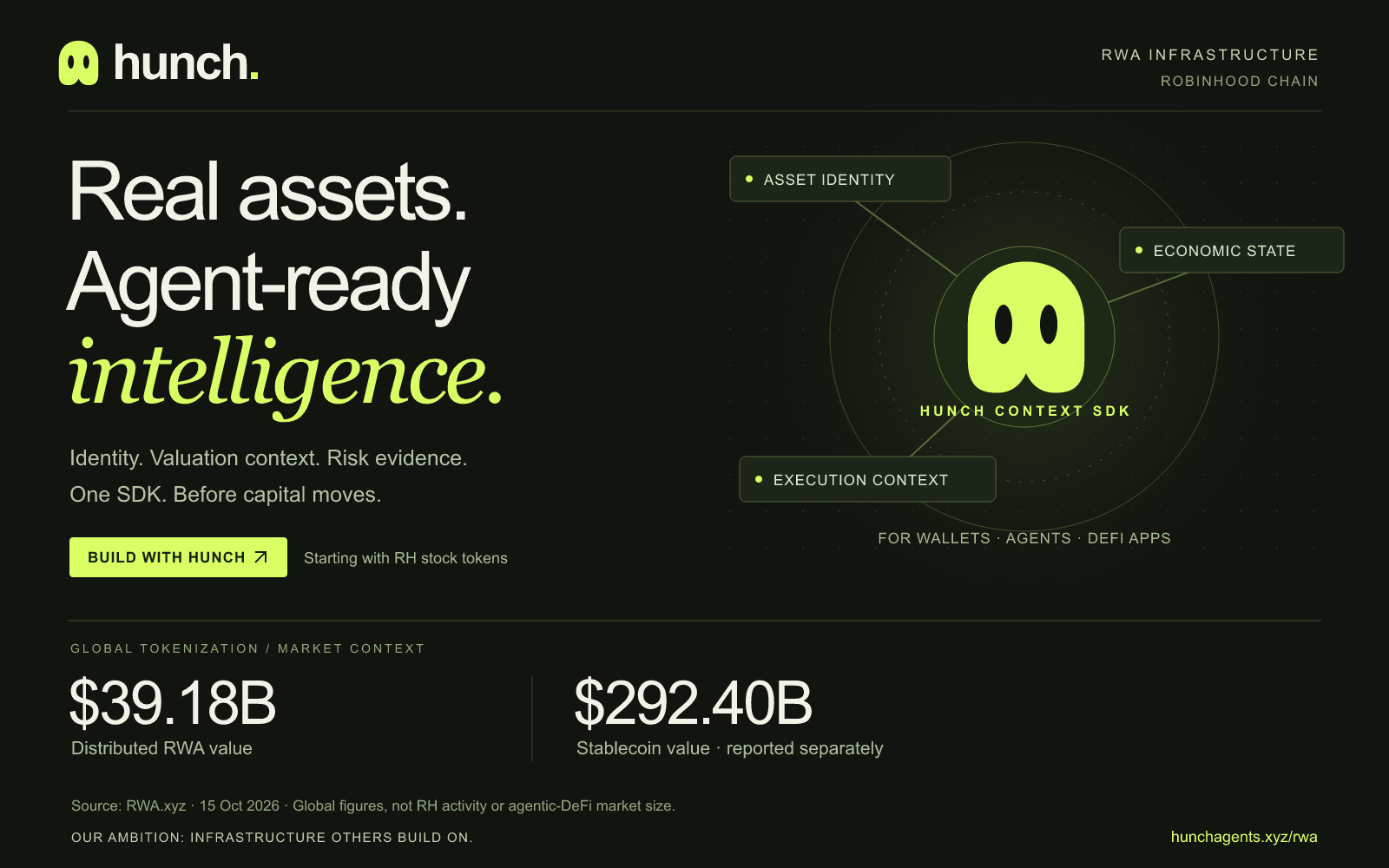
A market with real assets already onchain.
RWA.xyz reports $39.18 billion in distributed RWA value and, separately, $292.40 billion in stablecoin value in the dashboard snapshot reviewed on 15 October 2026.
These are global tokenization figures. They do not measure Robinhood Chain activity, Hunch's addressable revenue, or a proven market size for agent-executed DeFi. They show the financial assets and settlement instruments around which new software can be built.
Our thesis is that as agents participate in this market, instrument meaning and execution context become essential parts of their workflows.
A token balance does not tell the whole financial story.
On Robinhood Chain, a stock token's shares-per-token multiplier can change after a corporate action while its raw token balance stays the same. A REST price may describe the underlying share; an on-chain feed may already include the multiplier. Mixing those conventions can distort a position's valuation.
The same decision also depends on contract behavior, the assets on the other side of a pool, current trading state and the actual proposed call. A quote, token name or successful simulation answers only part of that question.
A common decision-context layer.
Hunch connects asset identity, financial meaning and risk evidence in a structured packet. The integration point sits between an application's proposed action and its trusted review and signing logic.
| Application | Where context helps |
|---|---|
| Wallets & agents | Present asset and action evidence before a signing decision. |
| Trading interfaces | Review the chosen asset and counter asset alongside a route's proposed call. |
| Lending & vault workflows | Reconcile instrument meaning during asset review and reference valuation. |
| Launch interfaces | Make contract behavior and available market dependencies readable. |
These are target workflows. Hunch does not claim live integrations or partnerships with the protocols in Robinhood's ecosystem. Venue-specific adapters, collateral eligibility, liquidation models and smart-account batch decoding still require implementation and validation.
One SDK call. The evidence stays attached.
The current getDecisionContext method combines contract intelligence, relevant instrument reports, a caller-selected counter asset and optional read-only simulation. Each packet retains source observations, gaps and a fingerprint of the normalized request.
import { HunchClient } from './hunch-sdk.mjs';
const hunch = new HunchClient();

const context = await hunch.getDecisionContext({
  address: '0xaf3d76f1834a1d425780943c99ea8a608f8a93f9',
  tokens: '2',
  counterAsset: '0x5fc5360d0400a0fd4f2af552add042d716f1d168'
});

// Current coverage returns review or block.
// Your trusted runtime owns policy and signing.
console.log(context.decision, context.reasons);
JavaScript SDK · TypeScript declarations · Python client · Integration guide
Live today: official RH instrument identity, stock-token multiplier reconciliation, halt/pause/freshness checks, recognized forwarding-contract analysis, indexed market context and EVM call simulation. Reports are unsigned and always require review or block. Complete permissions, holder concentration and decoded asset flows remain gaps.
Infrastructure others choose to build on.
We aim to make financial context reusable across RWA applications: a consistent integration surface instead of each team rebuilding instrument interpretation and evidence handling. We will earn that position through correctness, coverage, dependable service and working integrations.
The next milestones are validated venue adapters, deeper permission and holder evidence, oracle and sequencer checks, and persistent monitoring. The business model is paid intelligence usage and operator workspaces. Our proposed economics describes a surplus-funded buyback and burn policy; billing and burns are not enabled.
Sources and scope.
- RWA.xyz global dashboard, observed 15 October 2026. Figures are a dated snapshot.
- RWA.xyz tokenization framework: distributed assets can move outside the issuing platform and transfer between wallets, potentially subject to eligibility controls.
- Robinhood Chain ecosystem and network documentation.
- Stock-token instrument semantics and official API documentation.
Hunch is independent. No Robinhood, Hookr, Pons, wallet, exchange or lending-protocol endorsement is represented.